Bank of Korea Reports Reserves at $426.99 Billion on June 4, Down from $427.88 Billion.
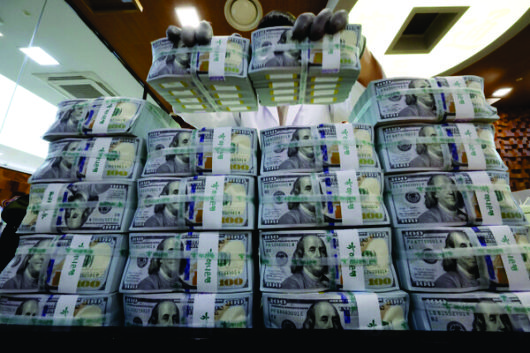
South Korea’s foreign exchange reserves decreased by $880 million in one month due to market stabilization measures, including a foreign exchange swap with the National Pension Service. The decline appears to reflect a slight reduction in the overall reserve level as the foreign exchange authorities injected funds to ease exchange-rate volatility.
According to data released by the Bank of Korea on June 4, the country’s foreign exchange reserves stood at $426.99 billion at the end of May. That was down by $880 million from $427.88 billion recorded at the end of the previous month. The Bank of Korea cited market stabilization measures tied to the foreign exchange swap with the National Pension Service as the main reason for the decrease.
By asset category, securities, which include government bonds, agency bonds and corporate bonds, came to $380.68 billion, down by $3.39 billion from the previous month. Securities accounted for 89.2% of total foreign exchange reserves, maintaining the largest share.
By contrast, deposits, which are cash-equivalent assets, rose by $2.59 billion from the previous month to $21.35 billion. Special Drawing Rights, or SDRs, at the International Monetary Fund fell by $30 million to $15.78 billion, while the IMF reserve position also declined by $60 million to $4.40 billion. Gold holdings remained unchanged from the previous month at $4.79 billion, based on book value that does not reflect market prices.
The value of major currencies moved in different directions against the U.S. dollar last month. The euro and the pound sterling depreciated by 0.2% and 0.3%, respectively, while the Australian dollar and the yen appreciated by 0.6% and 0.7%, respectively. The U.S. Dollar Index, which measures the dollar against the currencies of six major countries, stood at 99.02, up 0.1% from the end of the previous month and extending the strong dollar trend.
South Korea’s foreign exchange reserves ranked 12th in the world as of the end of April. In the country rankings, China remained the overwhelming leader with $3.4105 trillion, followed by Japan, Switzerland, Russia and India. Hong Kong, with $442.10 billion in reserves, ranked one place above South Korea.
Source: Businesskorea