Brazil’s Road to 8th-Largest Economy in 2027: What the IMF’s October Forecast Means for Oil
The Briefing:
- The IMF’s October 2026 World Economic Outlook projects Brazil as the world’s eighth-largest economy in 2027 at $2.80 trillion — a ranking it last held in 2017 — overtaking both Italy and Russia in a single-year jump from its current tenth-place position.
- Brazil’s national crude output already surpassed the 4.2-million-barrel-per-day level once projected for 2028, with production reaching a record 4.5 million barrels per day in July 2026; over the first nine months of 2026, China purchased approximately half of all Brazilian crude exports after the Strait of Hormuz was disrupted.
- The IMF trimmed its Brazil growth forecast to 2.2% for 2026 and 1.9% for 2027, both below July’s projections of 2.4% and 2.2%, citing restrictive interest rates, reduced fiscal support, and global trade uncertainty.
The International Monetary Fund now places Brazil as the world’s eighth-largest economy in 2027, at $2.80 trillion in nominal GDP — a climb from its current tenth-place standing that would put the country ahead of both Italy and Russia for that year. The forecast, released this week in the October edition of the IMF’s World Economic Outlook, represents the fastest two-position advance Brazil has registered in the global GDP rankings in more than a decade, underpinned by a deepwater oil expansion that has progressively reshaped the country’s fiscal base.
The move carries real strategic weight. A Brazilian economy firmly inside the global top eight would give Latin America’s largest nation greater leverage in trade negotiations, multilateral lending discussions, and investor-confidence surveys at exactly the moment the region needs a durable economic anchor.
A Two-Step Climb in Twelve Months
According to the IMF’s October 2026 World Economic Outlook database, Brazil finished 2024 and 2025 as the world’s eleventh-largest economy before reclaiming tenth place in 2026, then projecting to vault to eighth in 2027 — a trajectory that places it ahead of Russia’s projected $2.68 trillion and Italy’s projected $2.77 trillion for that year. The last time Brazil occupied that eighth spot was in 2017.
The same IMF dataset shows Brazil holding that eighth position through 2031, the final year covered by the projection window. The country’s historical peak ranking was seventh — a position it held in 1995 and then continuously from 2010 through 2014, a period shaped by elevated commodity prices and rapid credit expansion that eventually gave way to recession.
Nominal GDP rankings respond to currency movements as much as real output, and part of Brazil’s projected climb reflects how the real has traded against the dollar. Real GDP growth is forecast at 2.2% in 2026 and 1.9% in 2027 — modest for an emerging market, but sufficient in dollar terms to outpace both Italy and Russia across the forecast horizon.
The Oil Engine Behind the Surge
No single factor explains Brazil’s ascent more directly than hydrocarbons. Petrobras posted net income of R$52.4 billion ($10.4 billion) for the April-June 2026 period, up 97% from the same quarter the year before — one of the highest earnings totals in the company’s history. Record production volume powered that result: the company’s own oil output reached 2.7 million barrels per day, 15% above Q2 2025, with pre-salt operations accounting for approximately 82% of Petrobras-operated crude lifted. CFO Fernando Melgarejo was explicit about what drove the surge during the earnings presentation: “we did not have record Brent prices, but we did have record production.”
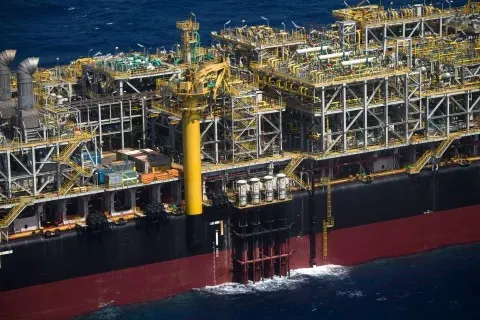
The deepwater pre-salt fields at Búzios and Mero sit at the technical heart of that growth. The Búzios platforms surpassed 1.219 million barrels of operated production per day on a single day in late June, and the P-79 platform at Búzios entered service three months ahead of schedule — the kind of execution consistency that has made the pre-salt basin the most commercially reliable offshore development on the planet.
China, India and the Post-Hormuz Scramble for Brazilian Crude
The Strait of Hormuz crisis that disrupted Persian Gulf traffic in early 2026 sent Asian buyers in search of alternative crude suppliers, and Brazil absorbed a substantial share of the redirected demand. In the first quarter of 2026, Brazil’s total oil exports surged 31% year-over-year to $12.56 billion, with China doubling its purchases to capture 57% of Brazil’s crude exports in Q1 alone. India, the second-largest buyer, absorbed roughly 15% of Brazil’s oil exports over the same period.
The nine-month picture through September 2026 tells an even more striking story. According to data from the Brazil-China Business Council reported by the South China Morning Post, China purchased approximately half of all Brazilian crude exports between January and September — oil sales to Beijing hit a record $21.8 billion, up 49% year-over-year, as Chinese refiners scrambled to replace cut-off Persian Gulf supply. India remained the second-largest buyer, with purchases up 165% year-over-year, though its volume ran at roughly one-seventh of China’s. Total Brazil-China trade reached a record $142 billion through September, generating a $26.1 billion surplus for Brasília.
Source: Latintimes